
The Twist of Mind
I had been feeling foggy and wanting to go on a solo trip. “To the mountains”, I had been telling myself.
But in a sudden twist, as I was about to book my tickets, a last minute voice from within said “Vrindavan”.
I’m not a religious person, and all I wanted was a change of scene. I wanted to go to some place serene & remote. But isn’t Vrindavan the opposite of all that?
Naturally, I felt conflicted. Regardless, I went.
Instant Regret
I love going to new places without any elaborate plans. I believe it satisfies my exploration-hungry soul. I knew absolutely nothing about this place as well.
As soon as I got off the bus, I was lost. Which direction to go in? All these auto-wallas were yelling something or the other. One said something I didn’t catch, but I nodded, just to get out of this mess. Was I regretting coming here two minutes after getting off the bus? A bit.
After fifteen minutes and a very bumpy ride later, I was dropped in the middle of the loudest and the most chaotic place I’ve ever seen.
The Shift
It was a Sunday night when I arrived at that bazaar. Loudspeakers blasting devotional music, people shouting to be heard, cars and bikes honking.
As I walked through the bazaar, I came across a street band of Westerners singing a Kirtan. Banjo, guitar, shakers, harmonium, all blending into something unexpectedly beautiful.
“Hare Krishna”, they sang.
“Not my genre, but uplifting,” I thought. I stood there for a bit and clapped along and smiled. Not a bad start.
Gradually, the chaos stopped bothering me.
By the end of the trip, I realised that Vrindavan is a place of contradictions, and somewhere within those contradictions lie lessons for life.
I walked further, absorbing everything. A series of statues of ancient saints caught my attention, and I lingered there for a while.
Now it was late, and I hadn’t even found a place to stay. After some searching, I found a room and called it a day.
Oneness
From one point of view, there was chaos, filth, and nothing conventionally aesthetic. From another, it simply didn’t matter. There was a quiet, pervading calm. Maybe ‘dirty’ is just a construct; maybe nothing really matters in the way we think it does.
Vrindavan gently nudges you towards that possibility.
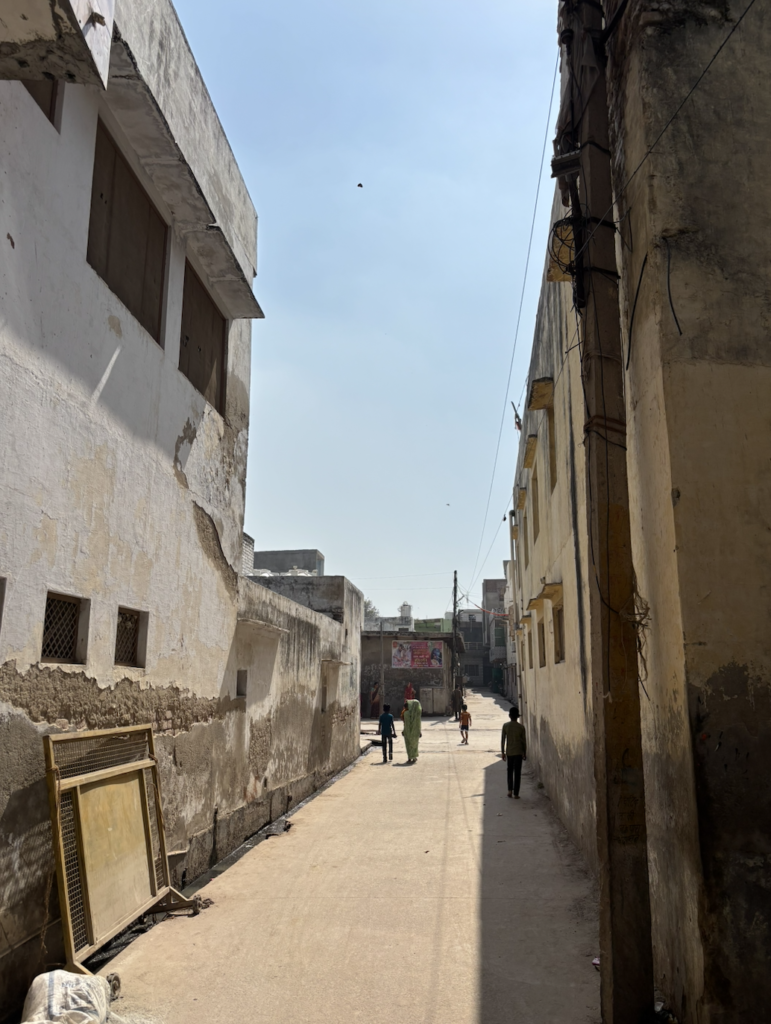
I wandered through narrow, twisted streets, passing by ashrams and temples. One Hanuman temple stood out.
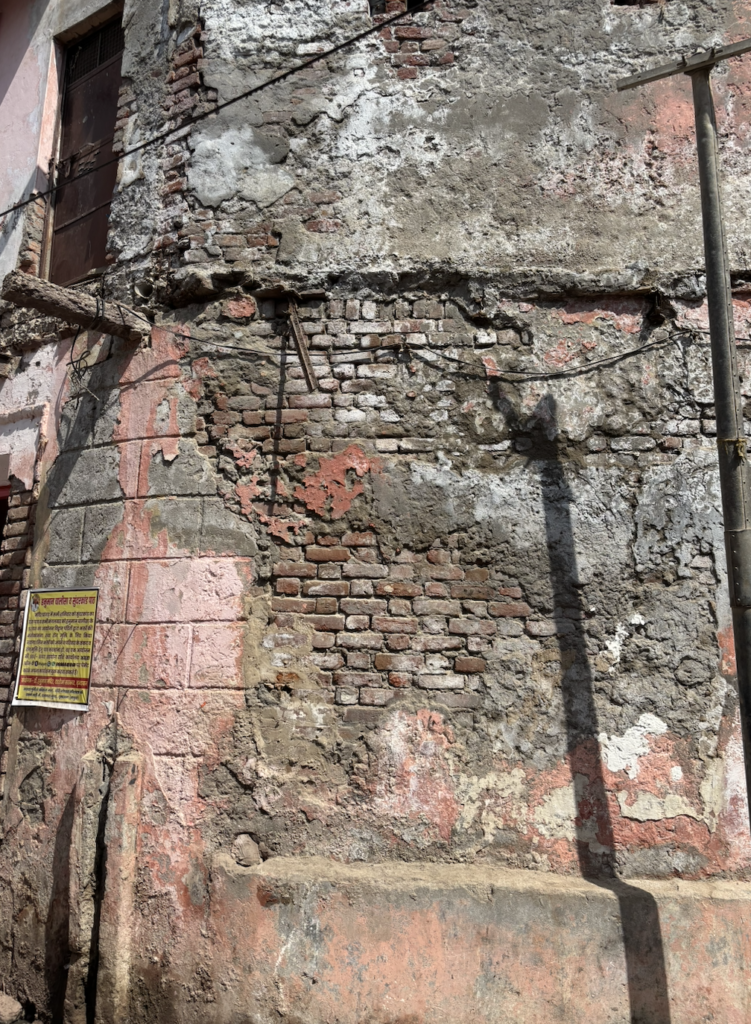
From outside, it looked frozen in time. Chipped walls. A tiny, dimly-lit shop selling flowers and prasad. Cow dung nearby, a monkey by a bicycle, and a pile of garbage.
And yet, somehow, none of it mattered.
I went inside, removed my shoes, washed my hands, and sat down. An old pujari sat on a takhat, reading what looked like the Bhagavad Gita.
As I settled in, a deep serenity took over, almost unexpectedly. I closed my eyes, and it felt easy to meditate, easy to get lost.
That, I realised, was the beauty of this place, far beyond material aesthetics.
Across the city, cows roam freely, monkeys might sit beside you, sadhus wander, temples hide in obscure streets, and together it all feels like one continuous consciousness, existing beyond time.
Picture: The outside wall of the temple that’s frozen in time
2,500 Rupees
After sitting in that temple for an hour, I stepped out. It was burning hot, the streets almost empty. I started walking without any destination in mind.
A frail voice came from behind.
“Garmi mein sar dhak kar chala karo beta”
There was an old lady, probably in her 60s, behind me.
“Itni dopahar mein kyu ghoomte ho, araam kar lo”
It was unexpectedly kind, warm, and almost maternal.
We spoke for a while. She told me she had moved here 15 years ago, lives alone, and walks two hours every day for work.
She told me that she needs just 2,500 rupees a month to get by, and that she’s content and deeply thankful to God, whom she believes protects her, and arranges circumstances for her so that she can earn her daily bread.
Around me, people earn that in an hour and are entangled in a never ending cycle of wanting more, including myself, I thought.
I still don’t know what exactly I learnt from that encounter, but her empathy and simplicity is something I’d remember for a long time.
I wish I would’ve walked a bit more to accompany her and listen to her speak. It was the best conversation I’d had all day.
Picture: One of the many streets I roamed
Countenance
Back in the temple, while sitting on the floor, I’d often glance at the Sadhu absorbed in his meditation.
Unfazed by the hot weather or the occasional chatter, he alternated between reading the Gita and slipping into meditation. And whenever he opened his eyes, there was a certain gravitas. A glimpse of Karma Yoga and Bhakti Yoga.
I came across a lot of Sadhu’s in Vrindavan, some doing meditation in temples & ashrams, some walking barefoot to somewhere, and some drinking tea and chatting with local folk. Most of them had a quiet wisdom on their countenance.
This Shit isn’t Real
I’ve met many people in Europe who are drawn to Vedic teachings; familiar with Yoga, the Bhagwad Gita, and the teachings of monks like Vivekananda and Ramana Maharshi.
Here too, many such people wander through the streets, temples, and ashrams; in their kurtas and sarees, embracing something very different from where they come from.
On another day, I met one such guy, from Estonia. When we met, we instantly felt connected, and ended up spending an entire afternoon together. We shared several conversations and long pauses.
“Europe is a comfortable place,” he uttered quietly, “but I come to India to experience my inner self”.
“Being here is a constant reminder that everything is part of a higher consciousness”.
“Meditation to me, is like having a nice cup of coffee, I feel calm and yet alert”.
He was spiritual and yet extremely practical. I’ve never heard anyone equate meditation to coffee, for sure.
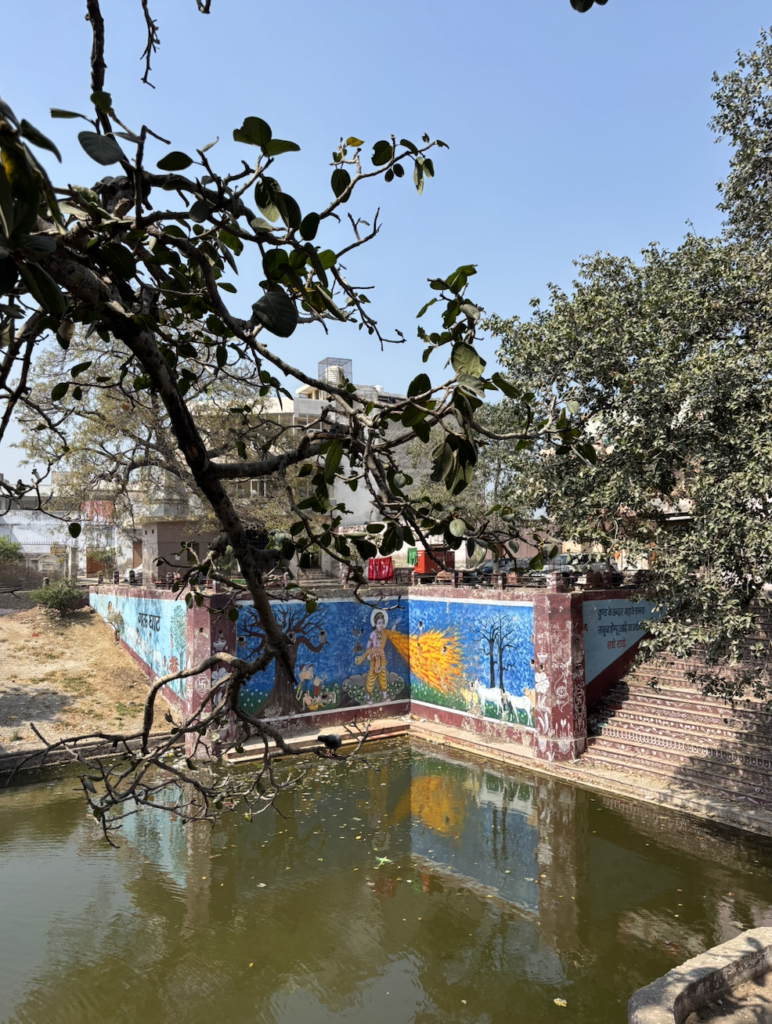
Behind us was a large, albeit a very dirty pond. I later came to know that it’s called Davanal Kund and it’s also linked to one of the million Leela’s of Krishna. There was an old shop in the distance and a large tree was shielding us from the sun.
Suddenly, a massive dump of shit fell on my jeans.
My mood flipped. My agitated self let out a couple of f-bombs. He, on the other hand, burst out laughing and suggested I clean it with leaves at the pond.
When I came back, he told me how a monkey had urinated on him twice in an ashram, and laughed about it for a full minute.
Isn’t most of life just about how we react? Is it really possible to reach a level of equanimity?
He had lost his brother during Covid, right in front of his eyes. As he spoke about it, his eyes filled up.
He had beautiful green eyes and a quiet smile. And a deeply humble presence.
I didn’t ask for his contact, I don’t know why.
But I’ll always remember Heler.
Picture: The pond besides which I had these heartfelt conversations
Sweet Boondi and Lullabies
Another day, even hotter.
Now bored of walking aimlessly, I took an e-rickshaw and asked to be dropped at any ashram nearby. After one of the bumpiest rides of my life, I reached a Neem Karoli Baba Ashram.
As I put off my shoes to enter, the hot cement floor immediately burned my bare feet and that stung for a while.
Once I was inside, though, I immediately liked the vibe. I sat down in the shade.
It was 2 PM, and I had overheard that there would be a ‘tea prasad’ distribution at 4 PM. So, I had two hours to kill before I’d get a free cup of tea. Yay!
I explored a bit. Inside one room, people were meditating. Then there was this small temple.
Inside, three women were singing “Hare Krishna, Hare Rama”. One on the dhol, one on the manjira, and one singing.
I closed my eyes and got lost in it. I even recorded it, thinking I might need it someday.
I went back in the courtyard, and dozed off for a few minutes.
When I woke up, it was time for prasad. I could smell the sweetness around me.
At 4 PM, in that quiet ashram, as I ate in a pattal, that warm and sweet boondi made in ghee, using my hands, and sipped the hot tea, I felt deeply nourished. It felt like heaven!
The prasad, people say, is a great healer. Maybe. Simplicity definitely is.
After listening to the musical chants, the nap, and the prasad, I felt completely recharged. I knew that it’s time to depart.
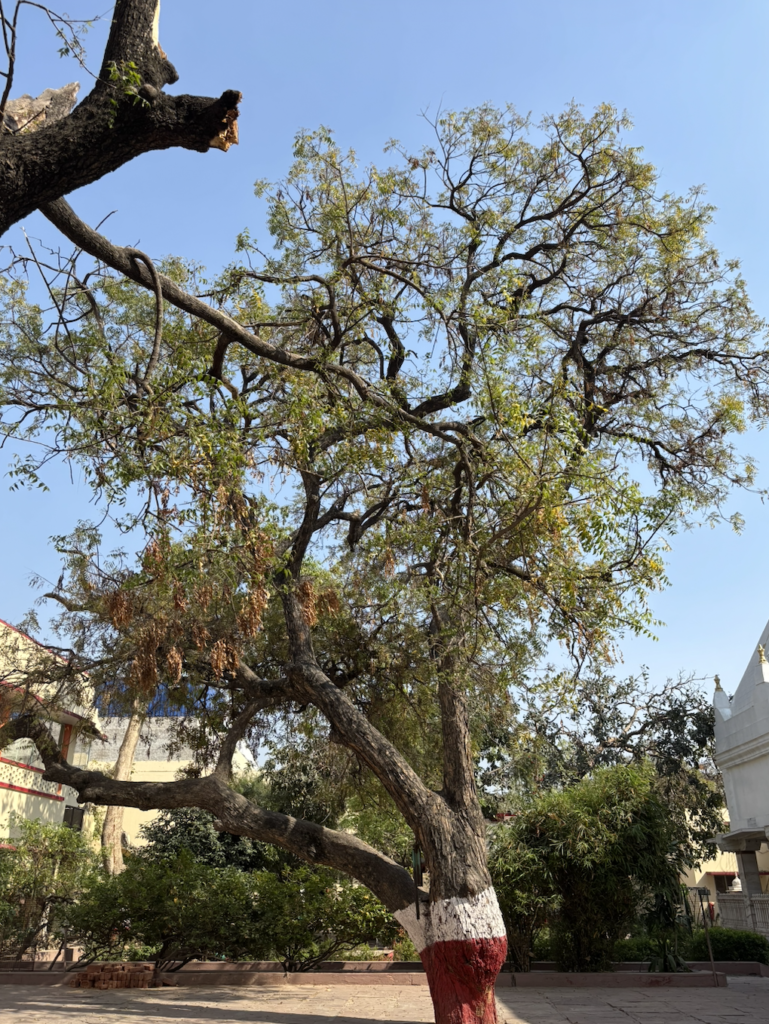
Picture: The Ashram view from where I sat and had sweet boondi and tea, absorbing the serenity
Karma Yoga
I’ve often been critical of the place of religion in the modern world.
However, I have benefited a bit from the teachings from some scriptures. The concept of Karma Yoga is something that resonates with me.
It’s a message that Krishna passes on to Arjuna: to act in the face of doubt, fear, and consequence, without attachment to the outcome.
In a way, we’re all modern-day Arjunas: stressed, confused, unsure of where we’re headed, and still, we have to keep doing what needs to be done.
At a Kirtan, I found myself wondering why people chant Krishna’s name. It always felt a bit dogmatic to me.
“Maybe it’s not just a word. Maybe it carries stories. Of love, duty, and friendship. And ideas about consciousness. Maybe chanting is a way of reconnecting with those ideas, even subconsciously”.
In that temple, with people singing and dancing, something shifted for me. This was the last lesson of this trip.
Coming Back to Life
As long as we know why we do what we do, it’s good, I think. And maybe even if we don’t, that’s fine too. Who are we to qualify it anyway?
I came back a bit tired but grounded. With a bit more clarity and a reinforced idea of Karma Yoga for the life ahead.
Sometimes, I feel that life is like Vrindavan: not what it seems and humbling. And unknowable.
